 Comparison
7 InCruiter Alternatives for Senior Hiring in 2026
Last Updated: October 26, 2026
Quick Summary
HireSphere AI is the strongest InCruiter alternative for senior hiring because it fixes criteria before the search, runs structured interviews, and delivers a ranked top three with written reasoning. Alignment Engine placements also carry a 12-month replacement guarantee, so risk shifts to the vendor.
- AI should propose scores and shortlists, but a named human must sign off before any candidate advances.
- InterviewFlowAI states $0.99 per interview, which suits high-volume first-pass screening rather than judgment-based assessment.
- A senior search usually runs three to five rounds with three to five finalists, so per-interview pricing multiplies fast.
- Ask every vendor for a written quote covering one senior search end to end, not a per-interview rate.
- Recording consent rules vary by state, and some require all-party consent, so notice and opt-out must be built in.
Table of Contents
- Why Senior Hiring Breaks Most Interview Platforms in 2026
- Recruitment Platform Comparison: What Changes for Senior Roles
- AI Interview Platforms: Where They Fit and Where They Fall Short
- Building a Structured Interview Process for Senior Candidates
- Senior Candidate Evaluation: Judging Depth, Not Keywords
- The 7 InCruiter Alternatives for Senior Hiring, Ranked
- Pricing, Oversight, and Data Governance: What to Check Before You Buy
- Book an Alignment Call to See the Shortlist Process
- Frequently Asked Questions
Why Senior Hiring Breaks Most Interview Platforms in 2026
The U.S. hires rate sat at 3.1% in February 2026 with 6.9 million open positions, according to Pin's Recruitment Statistics 2026. Senior roles are where that gap hurts most, and where most platforms quietly fail. An Incruiter alternative for senior hiring has to do something the volume-screening tools were never built for: judge depth, not keywords.
Here's the problem. Most interview platforms optimize for speed and cost per interview. That works for campus hiring and bulk hiring. It falls apart when you're filling a VP of Engineering seat where one bad hire costs a year.
This guide ranks seven alternatives with senior hiring in mind, and explains what to check before you buy.
Recruitment Platform Comparison: What Changes for Senior Roles
Senior hiring changes the evaluation criteria, the risk profile, and the cost math. A recruitment platform comparison built for entry-level volume will mislead you here.
The table below shows what shifts when the seat is senior.
| Factor | Volume Hiring | Senior Hiring |
|---|---|---|
| Primary filter | Keywords, years, stack match | Judgment, scope, decision quality |
| Interview format | Automated screening at scale | Structured deep-dive, human-led |
| Cost sensitivity | Cost per interview | Cost of a bad hire |
| Decision owner | Recruiter | Hiring executive and board |
| Failure mode | Slow pipeline | Wrong person, 12-month setback |
The single biggest difference: senior candidates ask harder questions about your process than you ask about their resume. A robotic, unstructured loop loses them.
AI Interview Platforms: Where They Fit and Where They Fall Short
AI interview platforms are strongest at the top of the funnel: phone screening, scheduling, and structured first-pass filtering. They are weakest exactly where senior hiring lives.
InCruiter's 2026 AI in recruitment analysis reports that 87% of companies use AI somewhere in their hiring process, though the report does not state its sample or methodology. Widespread use is not the same as proven outcomes.
Where AI screening earns its place
- Automated phone screening to cut first-round volume before a recruiter spends time
- Interview scheduling and coordination across time zones and panel calendars
- Interview proctoring and fraud detection on remote technical assessments
Where it falls short for senior roles
Assessing whether a director can set strategy under ambiguity, or whether a partner can hold a client relationship, needs a human interviewer with real domain depth. A model trained on screening transcripts can rank keyword coverage; it cannot reliably judge whether a candidate's trade-off reasoning holds up when the constraints change. The best setups pair conversational AI for logistics with expert interviewers for judgment.
The oversight model to demand before you buy
Ask every vendor to draw the line between automated and human-reviewed decisions. A workable model for senior hiring looks like this:
- AI proposes, human disposes. The platform may generate a transcript summary, a rubric score, or a ranked shortlist, but a named recruiter or hiring executive signs off before any candidate is advanced or rejected.
- Scores are visible, not opaque. You can see the rubric item, the evidence excerpt, and the model's confidence, and you can override any score with a written reason.
- Bias testing is documented. Ask for the vendor's adverse-impact testing method, the demographic groups tested, and the last test date. "We take bias seriously" is not an answer; a testing cadence and a named owner are.
- Accommodations are built in. Senior candidates may need extra time, an alternate format, or a live human instead of an asynchronous AI screen. The platform should support that without a custom ticket.
- Audit logs exist. Every AI-generated score, override, and deletion should be logged with a timestamp and user ID, because enterprise buyers and employment counsel will ask.
A vendor that cannot show you, in writing, which decisions are automated and who reviews them is asking you to accept unmanaged risk on your most expensive hires. Treat that as a disqualifier, not a negotiation point.
What this means for a senior search
Use AI where it compresses logistics, scheduling, transcript capture, structured first-pass scoring, and keep the judgment calls with a human who has done the job. The practical test: if the platform cannot tell you which of its outputs a recruiter is required to review, it was built for volume, not for the seat you are filling.
Building a Structured Interview Process for Senior Candidates
A structured interview process for senior candidates works by fixing the criteria before the search opens, then scoring every candidate against the same bar.
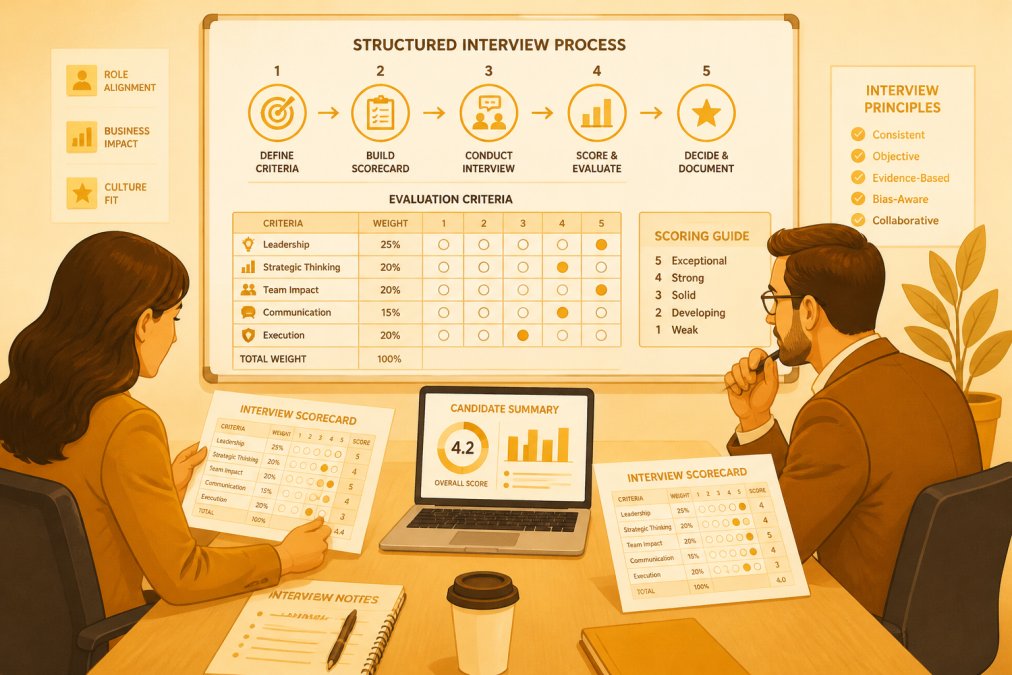
The sequence we recommend:
- Write the criteria document and get sign-off from the hiring executive
- Define what "strong" and "weak" look like for each criterion
- Run the same question set with every candidate
- Score independently before the debrief
- Rank on the total, then write down the reasoning
For a full walkthrough, see the three stages of an evaluated hire. The order matters: criteria first, candidates second. Reversing it is how bias enters.
Senior Candidate Evaluation: Judging Depth, Not Keywords
Senior candidate evaluation is the practice of scoring how a person thinks and what they have actually done, using criteria written before the search began. Keywords tell you what someone touched.
A common mistake is weighting pedigree over evidence. A candidate from a famous company may have inherited a working system. A candidate from a smaller firm may have built one from nothing.
We score senior candidates on four axes: scope of ownership, quality of decisions under constraint, ability to explain trade-offs, and evidence of outcomes. Every candidate gets the same scale. You can see how we evaluate, including the scoring architecture and a worked example.
The 7 InCruiter Alternatives for Senior Hiring, Ranked
The seven alternatives below are presented for senior hiring specifically, weighing human oversight, evaluation depth, and total cost over raw screening volume.
HireSphere AI: Ranked Shortlists With Written Reasoning
HireSphere AI runs a structured, repeatable hiring system for senior roles. Read anonymized client accounts of what clients bought and what they received. We define the criteria with you, run the structured interviews, and hand back a ranked top three with the reasoning written down.
Best for: scaling tech companies and professional services firms hiring senior talent without an internal evaluation function. Skip if: you want a self-serve screening tool you operate yourself.
Intervue: Technical Interview Comparison and Tiered Pricing
Intervue publishes a direct comparison with InCruiter across interview experience, reporting, and integrations. It targets technical hiring and uses tiered pricing to cut costs on lower-experience hires. Pricing is contact-only.
Best for: teams comparing technical interview platforms across experience levels. Skip if: you need published pricing before a demo.
InterviewFlowAI: Autonomous Screening at $0.99 per Interview
InterviewFlowAI offers autonomous AI phone and video screening at a stated $0.99 per interview (InterviewFlowAI's alternatives roundup). That price is hard to beat for top-of-funnel volume. The supplied materials don't verify senior-specific evaluation features.
Best for: high-volume first-pass screening on a tight budget. Skip if: the seat requires judgment-based assessment.
R1Interview: Pay-Per-Interview and Annual Enterprise Plans
R1Interview offers pay-per-interview pricing plus annual enterprise plans, with a free demo for HR and staffing teams. USD pricing is mentioned but amounts aren't published.
Best for: staffing teams that want flexible billing across global recruitment. Skip if: you need transparent USD rates up front.
Pricing, Oversight, and Data Governance: What to Check Before You Buy
Most alternatives pages stop at the headline price. For a senior search, the headline price is the smallest part of the number. The real comparison is total cost of ownership across a full search, plus the governance terms that protect a confidential process. Competitors rarely put both on one page; this section does.
The four pricing models you will actually encounter
- Per-interview. A stated fee per completed screen or interview. Attractive at the top of the funnel, but senior roles need multiple rounds and human interviewers, so the per-unit price multiplies fast.
- Flat-rate interview packs. A fixed fee for a bundle of interviews, which makes budgeting predictable but can leave unused capacity if the search closes early.
- Annual enterprise contracts. A platform fee plus usage, common for teams running continuous senior pipelines. Negotiate the usage ceiling and overage rate in writing.
Total cost of ownership: the line items to add up
A full senior search typically includes costs the headline price hides. Build a spreadsheet with these rows before you compare vendors:
- Platform or subscription fee, monthly or annual, per seat or per requisition.
- Per-interview or per-candidate usage, multiply by the realistic number of rounds (usually three to five for a senior seat) and the number of finalists (usually three to five).
- Human interviewer fees, expert interviewers are often billed separately, sometimes hourly. This is the line item most likely to blow the budget.
- Implementation and setup, configuration, rubric build, integrations, and training. Ask whether it is included or billed as professional services.
- Integrations, ATS, calendar, and video connectors may carry setup or per-connection fees.
- Support tier, priority support and dedicated account management are frequently upsells.
- Switching and operational effort, the internal hours to migrate requisitions, retrain recruiters, and run a pilot. This is a real cost even when it is not an invoice.
Ask every vendor for a written quote covering a single senior search end to end, not a per-interview rate. The vendor that can produce that quote is the one that has actually sold to senior hiring teams.
Oversight and data governance for confidential searches
Senior candidates are often known in the market, which raises the stakes on privacy and consent. Check four things before signing:
- What candidate data is analyzed, and who decides. Get the data map in writing: what is collected, what the model processes, and which employee can approve a new use.
- Consent and notice rules for recorded interviews. Recording consent rules vary by state, some require all-party consent, so the platform must support jurisdiction-appropriate notice and a recorded opt-out.
- Retention and deletion. Ask for the default retention period, whether transcripts and recordings are deleted on a schedule, and how a candidate exercises a deletion request. A vendor that cannot answer the deletion question in writing is a compliance risk, not a bargain.
For how we handle these, read our candidate privacy and process notice. The short version: consent is captured before recording, retention is time-bound, and every AI-generated ranking carries a named human reviewer.
Book an Alignment Call to See the Shortlist Process
HireSphere AI gives you a ranked top three with written reasoning, criteria signed before the search, and a 12-month replacement guarantee on Alignment Engine placements. You can book an Alignment Call to see how the shortlist process works for your next senior seat. Get started with HireSphere AI and turn a subjective interview loop into a repeatable hiring system.
Frequently Asked Questions
What are the top alternatives to InCruiter for senior hiring?
The strongest options split by model. HireSphere AI runs a structured evaluation and delivers a ranked top-three shortlist with written reasoning, backed by a 12-month replacement guarantee on Alignment Engine placements. Intervue publishes side-by-side technical interview comparisons with tiered pricing. InterviewFlowAI handles autonomous phone and video screening at a stated $0.99 per interview. R1Interview offers pay-per-interview and annual enterprise plans. For senior roles, weigh evaluation depth and human oversight over per-interview cost.
How do AI interview platforms evaluate senior candidates?
Most AI interview platforms screen on structured questions and score answers against a rubric. That works for early-career volume, but senior evaluation depends on criteria written before the search, interviewer expertise, and documented reasoning. HireSphere AI builds the criteria first, runs structured interviews, and returns three ranked candidates with written justification. Ask any AI interview platform how it handles judgment calls, escalation to a human interviewer, and bias controls before you commit to a senior search.
What should a structured interview process include for senior roles?
Start with criteria written before candidate review, so scoring is not shaped by first impressions. Use the same question set across candidates, separate technical depth from leadership and decision-making, and record written evidence for each rating. Add a defined escalation path for close calls. HireSphere AI packages this into a repeatable system and a ranked shortlist, which gives boards and buyers a readable record of why each hire was made.
How long should a senior hiring process take?
Six weeks is a realistic target when criteria are defined up front and interview scheduling is automated. Delays usually come from unclear requirements and unstructured debriefs, not from candidate supply. The U.S. hires rate was 3.1% in February 2026 with 6.9 million open positions, so senior candidates are moving quickly. A structured system with a ranked shortlist compresses the decision stage, which is where most senior searches lose weeks.
What is the difference between an interview platform and a full-cycle hiring service?
An interview platform supplies tools: scheduling, video, question banks, and scoring. A full-cycle hiring service runs the evaluation and hands you a decision-ready result. HireSphere AI sits in the second category, managing criteria definition through structured interviews and delivering a ranked top-three shortlist with written reasoning. If your team already has strong technical interviewers, a platform may be enough. If leadership lacks the bandwidth or stack depth, a service removes the burden entirely.